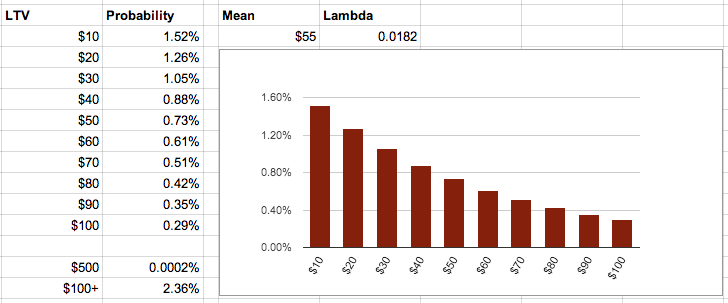
The benefits of low conversion in freemium A freemium product’s monetization profile is, essentially, dictated by its conversion rate and total addressable market. In a marketplace vacuum, given… June 30, 2014
Yo and the gimmick app economy In late May, a messaging app named “Yo” was submitted to Product Hunt, the product discovery website that has recently… June 23, 2014
Dealing with “whales” in freemium data analysis The presence of “whales”, or highly-monetizing users (HMUs), in a freemium product’s user base often leads to analytical confusion. Contrasted… June 16, 2014
Analyzing free-to-play games development: the Game / Team Clock (This is a guest post by Raul Aliaga, a senior game designer and producer. You can read more from Raul… June 9, 2014
Freemium conversion and the problem with classifiers Given the fundamentally low conversion rate of the freemium model, optimizing for revenues can be seen as essentially a targeting… June 2, 2014
Twitter’s ad network difficulties, visualized in three charts In late April 2014, Twitter announced it would be launching an integrated platform, ads.twitter.com, to allow mobile advertisers to manage campaigns… May 26, 2014
Emerging ad formats in mobile user acquisition The astonishing upward trajectory of Facebook's stock price -- documented in the above chart between June 2012 and May 2014 -- was catalyzed in… May 19, 2014
Low conversion in free-to-play is a feature, not a bug An article excoriating the supposed plague that is free-to-play made the rounds recently, citing engagement statistics from Swrve's April report… May 12, 2014
The Freemium Codex Freemium, as a business model, is not fairly well defined from an academic perspective -- that is, its application to,… May 5, 2014
Avoiding Simpson’s paradox in data analysis Simpson's paradox is a statistical phenomenon in which a population, comprised of different sub-populations (“classes”) with differing statistical properties, exhibits… April 28, 2014